
How-to
How to raise a virtual pet together without making it a chore
Sharing a virtual pet is sweet right up until it starts to feel like a shared to-do list. Here’s how to keep it a ritual you both look forward to.
A pet you raise with someone else is a tiny shared project. It gives you a reason to check in, something to talk about, and a little story that grows over weeks. It can also quietly turn into “whose turn is it?” if you’re not careful.
The tips below come from how we designed Lovegotchi and from watching pairs play it, but most of them apply to any shared pet app.
Start with one genuinely shared pet
The difference between “we both have a pet” and “we have a pet” matters more than it sounds. When your actions land on the same pet, you can see each other’s care. Open the app after your partner and Mochi is already fed and happy — that’s a small, wordless “I was here.”
In Lovegotchi, one person creates a shared home and sends an invite code; the other enters it. After that you both see the same Mochi, the same room, and the same progress.
Learn the whole care rhythm, not just feeding
Most virtual pets have several needs, and variety is what keeps care from becoming repetitive. Mochi has seven care actions, each with a short cooldown before it can be used again:
| Action | What it does | Cooldown |
|---|---|---|
| Feed | Fills hunger | 15 minutes |
| Play | Big happiness boost (uses some energy) | 10 minutes |
| Cuddle | Fills love and adds happiness | 5 minutes |
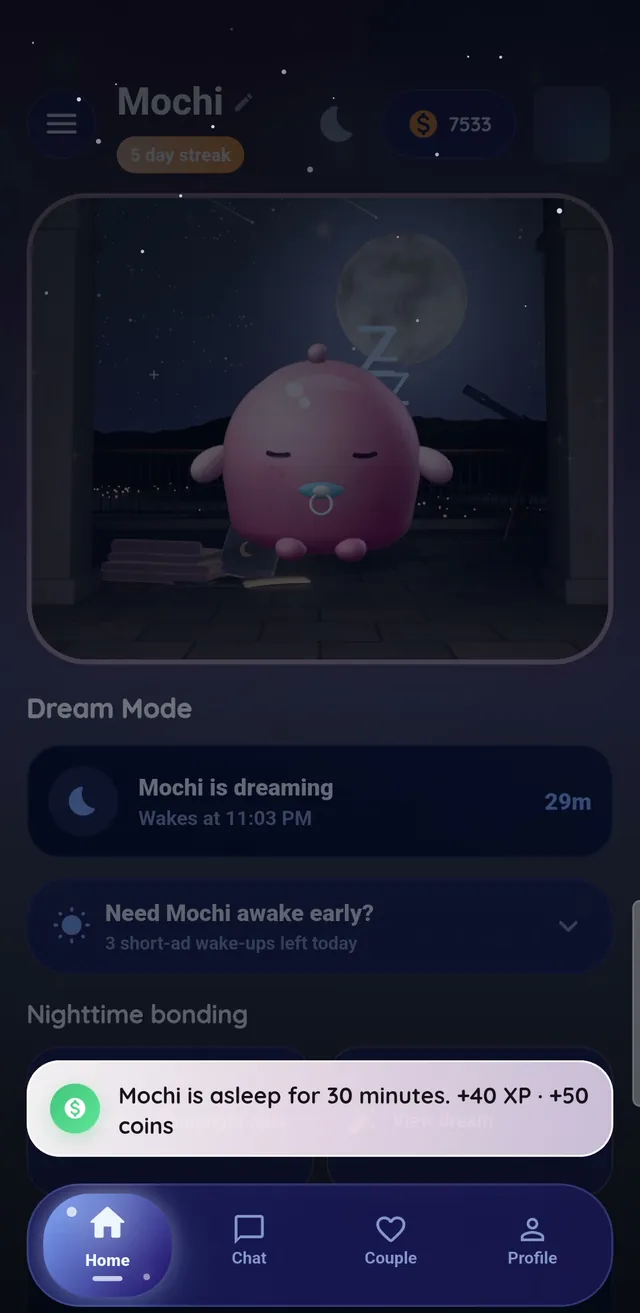
| Sleep | Restores lots of energy; starts Dream Mode | 30 minutes |
| Rest | A short nap for a bit of energy | 3 minutes |
| Bathe | Makes Mochi clean again | 20 minutes |
| Talk | A little love and happiness | 5 minutes |
Because cooldowns are short, there’s almost always something either of you can do when you open the app. That makes it easy to contribute without coordinating.
Split the day, not the chores
Rotas (“you feed, I bathe”) sound fair but make the pet feel like housework. A lighter approach is to split by time of day:
- Morning person: feeds Mochi and plays once before work or class.
- Evening person: bathes, cuddles, and puts Mochi to sleep.
- Whoever notices: anything in between.
This works especially well for long-distance pairs in different time zones — the pet effectively gets looked after around the clock.
Use streaks as a celebration, not a test
Lovegotchi tracks a shared streak: consecutive days where you showed up. Streaks are motivating, but they can also create guilt. A few ground rules help:
- Agree that a broken streak is no big deal. You can always start a new one.
- Never use the pet’s mood or the streak to win an argument.
- Celebrate milestones out loud — “we hit a week!” — rather than tracking misses.
Make the long-term goals joint decisions
Growth gives a shared pet its arc. Mochi hatches at level 3 and keeps evolving until she becomes a Legend at level 50. Talk about the next stage you’re excited for, which room you want next, or which skin to save coins for. Decisions you make together are half the fun.

Check in about the experience every so often
If one person ends up doing most of the care, that’s worth a light conversation — not because the pet needs fairness, but because it might mean the routine doesn’t fit someone’s life. Change the time of day, turn on reminders with quiet hours, or simply agree that some weeks will be lopsided.
Keep it small
A shared pet works best as a side dish, not the main course. It’s a nice way to stay part of each other’s day — not a replacement for calls, dates, or real conversations. If it ever starts feeling heavy, take a break — just tell your partner, so one of you keeps checking in and Mochi isn’t left alone for too long.
Keep reading

Daily rituals that help long-distance couples feel closer
Small daily rituals for long-distance couples, with a sample routine across time zones: morning handoffs, ordinary photos, a shared pet, a weekly look-back.
Read the article →
Getting started with Lovegotchi
A step-by-step guide to Lovegotchi: install, sign in, create your Mochi, share your 6-character partner code, and make your first care moments count.
Read the article →
How to care for your Mochi
What Feed, Play, Cuddle, Sleep, Rest, Bathe and Talk do in Lovegotchi, their cooldowns, what Mochi’s moods mean, and how to keep her happy together.
Read the article →